
Redefining subsurface imaging.
Greater depth. Unmatched resolution.

Next-Generation GPR Technology
We are pioneers in the development of a industrial Frequency-Modulated Continuous Wave (FMCW) ground penetrating radar — a next-generation system offering significant advantages over traditional pulse and SFCW radars.
Our goal was clear: to build a GPR system that maintains high resolution while penetrating significantly deeper than currently available commercial solutions. Our technology combines the high imaging resolution typical of radar systems with the depth penetration traditionally associated with other geophysical methods — offering the best of both worlds in a single solution.
All-in-One
Radar utilizing a single transmit-receive antenna, which can be integrated into arrays of multiple antennas.

AIO single-antenna SGPR
IQ STD 60
All-in-One
Radar utilizing a single transmit-receive antenna, which can be integrated into arrays of multiple antennas.
AIO single-antenna SGPR
IQ STD 60
Embedded Linux
Ensures full programmability and enables quick configuration and seamless adaptation of the device to a wide range of tasks.
Built-in LTE Module
Allows remote access to the radar for monitoring its status and measurement quality. It also enables quick diagnostics and troubleshooting anywhere in the world.
Full Coherence
Due to synchronization via GPS or fiber optic links, our radar units can be combined into virtually any antenna configuration, supporting advanced setups tailored to specific use cases.
Antennas
We design and manufacture state-of-the-art wideband antennas optimized for deep penetration and high-resolution imaging. Our antenna systems are integral to unlocking the full potential of our radar, enabling precise, reliable data collection in the most demanding conditions.

IQ STD 60
Circular polarisation high-frequency antenna designed to deliver extremely high-resolution images for applications in construction and infrastructure. Ideal for surveying, mapping, and monitoring the integrity of infrastructure.

BIG 180
Our low frequency antennas are specifically designed for deep probing in open-pit mining, making them ideal for projects requiring complementing the geological model or as a complementary tool for other geophysical methods such as seismic.

DEEP Rough Terrain
Cable antenna that enables operation at very low frequencies, resulting in very deep penetration — exceeding 100 meters in favorable conditions. Thanks to its design, it can be used in very challenging terrain conditions, making it ideal for mining exploration.
Circular polarisation
Simultaneously, we collect data from X, Y, and circular XY polarization. This allows us to analyze the anisotropy of subsurface layers, observe linear objects, and perform analyses based on Stokes parameters or the depolarization ratio.
IQ STD 60STANDARD
100-500 MHz
Circular polarisation high-frequency antenna designed to deliver extremely high-resolution images for applications in construction and infrastructure. Ideal for surveying, mapping, and monitoring the integrity of infrastructure.
BIG 180DEEP
35-200 MHz
Our low frequency antennas are specifically designed for deep probing in open-pit mining, making them ideal for projects requiring complementing the geological model or as a complementary tool for other geophysical methods such as seismic.
DEEP Rough TerrainGRANT
5-12.5 MHz
Cable antenna that enables operation at very low frequencies, resulting in very deep penetration — exceeding 100 meters in favorable conditions. Thanks to its design, it can be used in very challenging terrain conditions, making it ideal for mining exploration.

Advanced Data Processing
One of the main advantages of using SGPR is the abundance and diversity of data obtained during measurements. To fully harness the potential of our hardware, we are developing dedicated software that allows for advanced data processing without the need to limit ourselves to the formats available on the market.
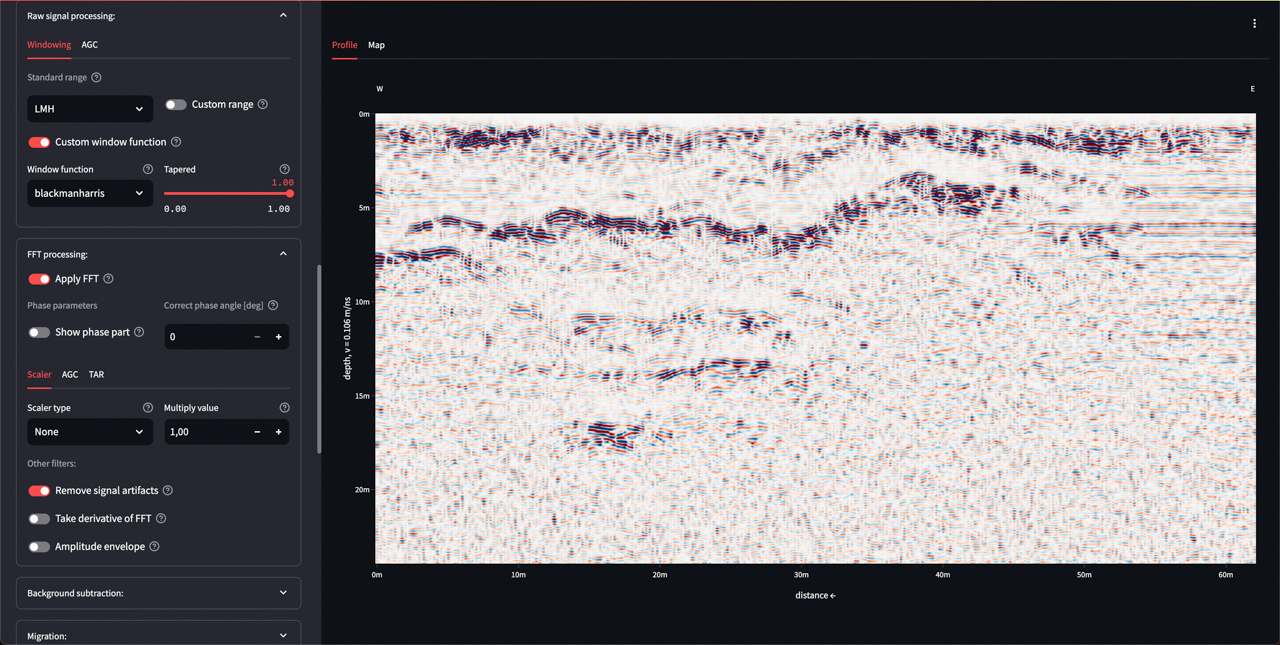
Cloud platform
We have created a dedicated cloud platform where data collected by our SGPR radar is automatically uploaded after survey.
Comparison
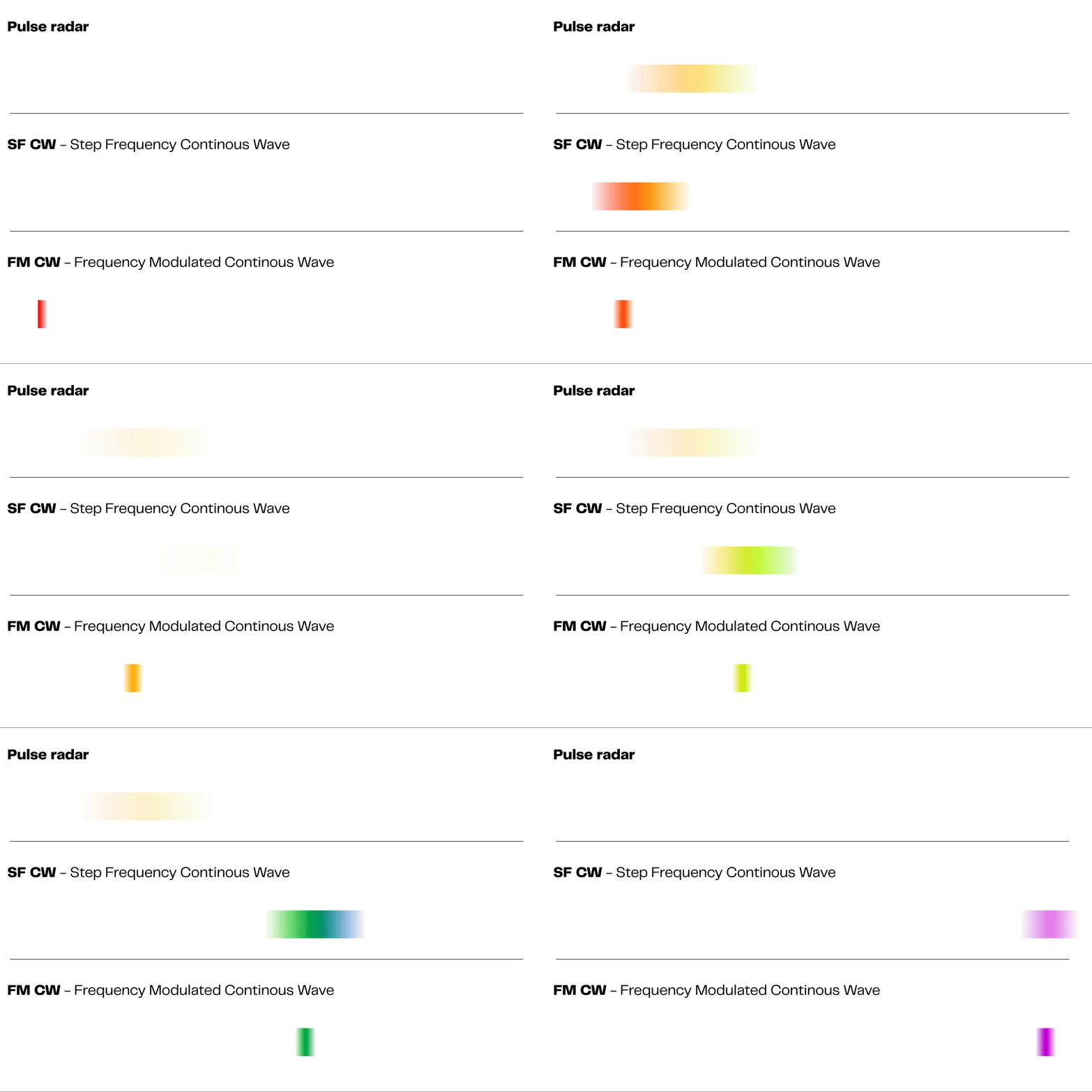
Thanks to the significantly improved signal-to-noise ratio and continuous sweeping over a wide frequency range, SGPR allows for much deeper penetration while maintaining high resolution, compared to currently available pulse or SF CW ground-penetrating radars.
FMCW vs other radars
FMCW allows for much more sophisticated data acquisition, collecting precise information across the entire spectrum.
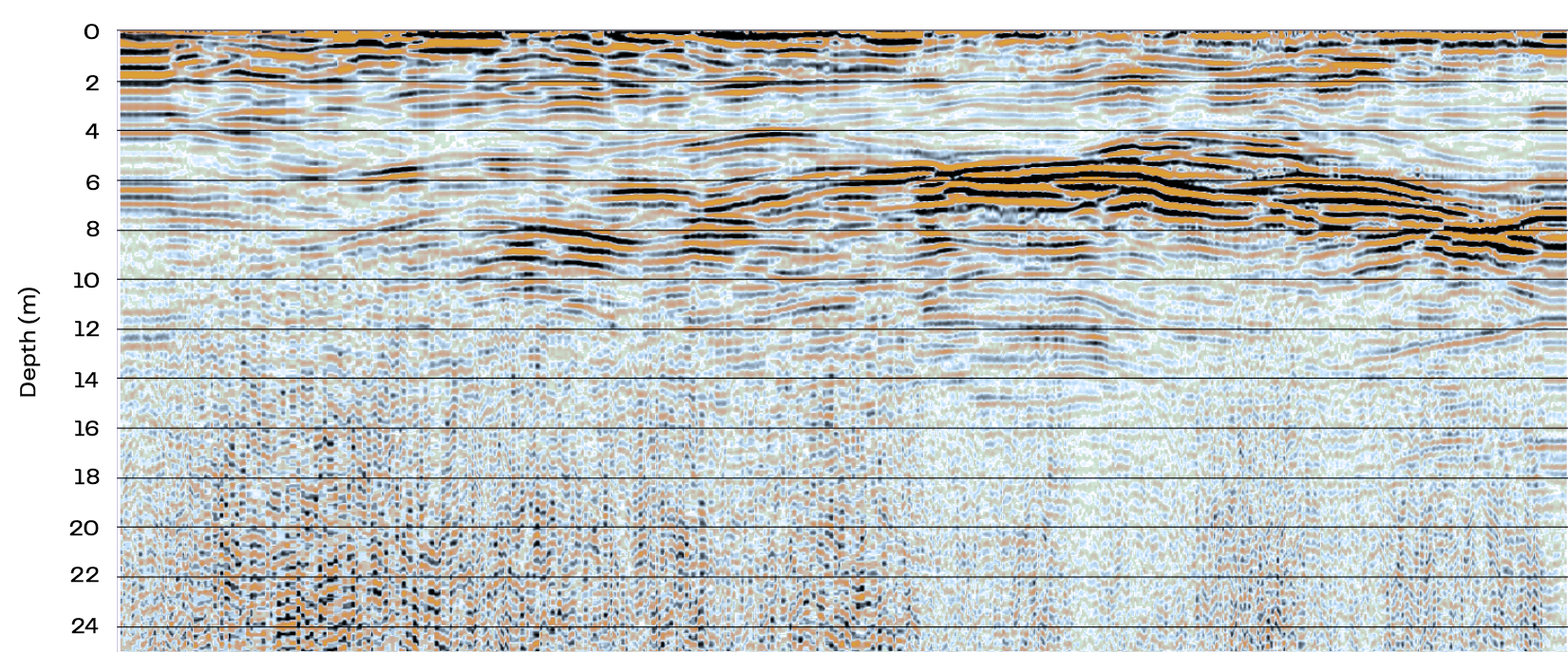
Pulse GPR (80MHz) vs SGPR (100-500MHz)
The data were processed by an external expert using commercially available geophysical processing software to ensure complete objectivity.
Left: Conventional pulse GPR with 80MHz antenna
Right: Single-antenna SGPR with IQ STD 60 (100-500MHz) exported to SegY
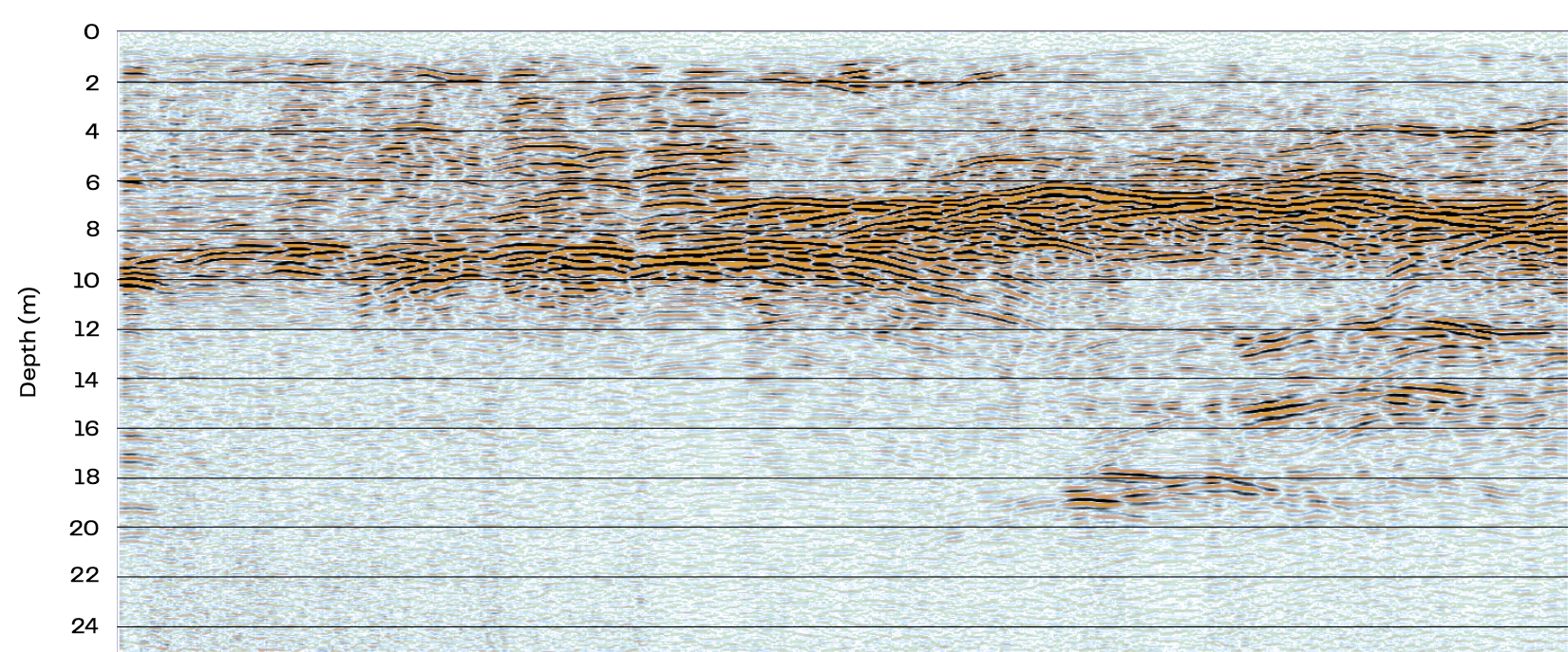
Pulse GPR vs SGPR
The data were processed by an external expert using commercially available geophysical processing software to ensure complete objectivity.
Left: Conventional pulse GPR with 80MHz antenna
Right: Single-antenna SGPR with IQ STD 60 (100-500MHz) exported to SegY